A logarithm you can play
iWalk up the keys and watch every note multiply by 1.06. Twelve steps = one doubling.
for teachers: exponents · logarithms · 12th root of 2Open →
Never touched a keyboard? Start with the big button — you will be playing a tune in about five minutes.
eighty-eight keys · the math & physics of the keyboard
Every other instrument hides its math. The piano puts it in a straight line you can touch: equal steps along the keys are equal multiplications in pitch. Learn the keyboard and you've learned exponents, logarithms, and the powers of two — by ear.
tap a marker to learn the part
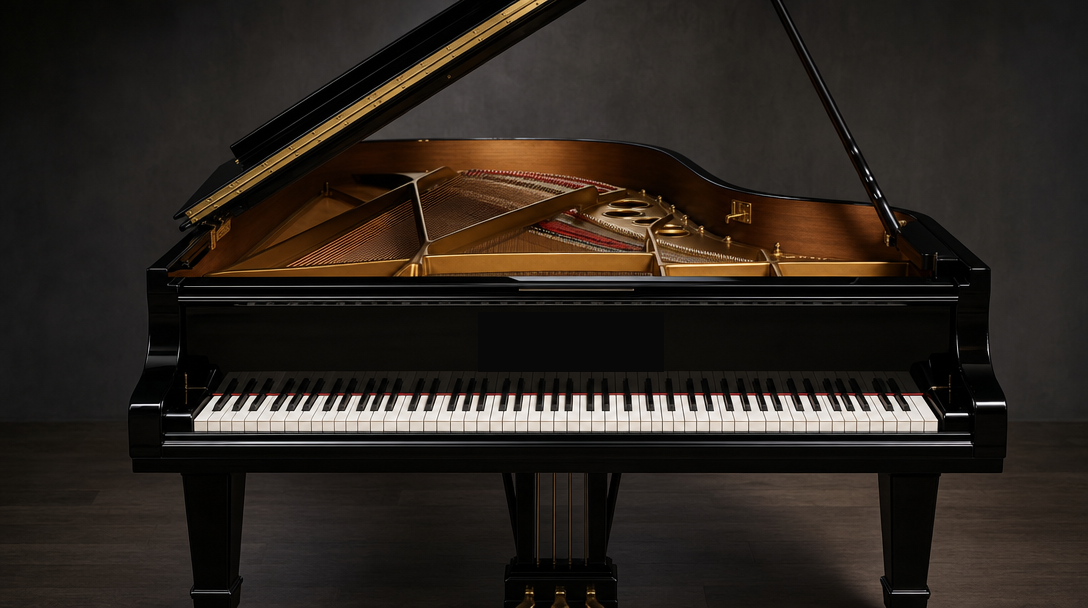
Lid up, you can see the whole harp: the strings run long on the left and short on the right — that is the pitch, laid out as a length.
play it — a real grand piano, sampled note by note
Tap or drag across the keys. Every white key is marked; the bold letters are the C's — your landmarks.
the same still points, on a piano string
A piano string is tied down at both ends, exactly like a guitar's, so it plays by exactly the same rule: it can only vibrate in whole loops, and every one of those loops has still points at each end. But a piano string is hit, not plucked — and where the hammer lands turns out to be a decision somebody made, on purpose, about which note to leave out.
move the hammer and watch harmonic 7 wake up or go quiet
strength of harmonic n ∝ sin(nπp)p = 0.143 of the way along
draw harmonic
how much of each harmonic this hammer wakes up
Tap a bar to hear that harmonic on its own. A bar goes to nothing when the hammer has landed on one of that harmonic's still points — you cannot start something moving by hitting the one spot that never moves.
the note the piano quietly leaves out
Set the hammer to 1/7 and watch the 7th bar collapse. Harmonic 7 has still points at 1/7, 2/7, 3/7… — so a hammer landing on 1/7 arrives at a place that harmonic never moves, and barely wakes it at all. The same blow also flattens the 14th and the 21st, for the same reason.
And harmonic 7 is exactly the one you would want asleep. Seven times the frequency lands 1200 × log₂7 = 3369 cents above the note — about 31 cents below the nearest key on the keyboard, roughly a third of a semitone out. Against the piano's own tuning it sounds sour and clangy. Hit the string a seventh of the way along and it never really shows up.
Real pianos use somewhere between 1/7 and 1/8, moving nearer the end as the strings get shorter and higher. It is not a rule of nature; it is two centuries of makers listening, and landing on the same fraction.
hear it for yourself
The third button is what a piano would sound like if its hammer hit in the wrong place. Listen for the buzz sitting on top of the note.
the math & physics of this instrument
Each one is a short lab you can run in front of a class — with a sound to poke and a “for the classroom” card at the end.
Walk up the keys and watch every note multiply by 1.06. Twelve steps = one doubling.
Every octave doubles the number: 55, 110, 220, 440. Powers of two you can hear.
Why 12 keys? Twelve fifths nearly equal seven octaves — but miss by a whisker.
Pure fifth vs piano fifth: hear them wobble against each other. That wobble is the math.
Keep adding fifths and you tour all twelve notes. Add thirds and you only ever see three. That's gcd.
New to it? Learn the basics — notes, chords & first tunes →
Wondering why the hammer hits where it does? See the still points on a piano string →
Bringing this to a classroom? See the school workshops → or explore the cross-instrument Math Lab →
the maths & physics of this instrument
Eighty-eight keys laid out in a straight line, evenly spaced — and the frequencies behind them are not evenly spaced at all. They multiply. Walking up the keyboard one key at a time means multiplying by the same number over and over, which is exactly what a logarithmic scale is; the piano just happens to be one you can sit at.
Indices · exponential growth
f = 440 × 2^((n − 69) ÷ 12). One key up is × 2^(1/12) = 1.0595. Twelve of those compound to exactly 2 — an octave.
Equal steps to your hand, equal ratios to your ear: the definition of a logarithmic ruler.
open it →
Modular arithmetic · highest common factor
Step by s semitones round the twelve and you visit 12 ÷ gcd(s, 12) notes before returning. Fifths (s = 7) visit all twelve; major thirds (s = 4) visit only three.
The circle of fifths isn't a music-theory diagram to memorise — it's what gcd does, made audible.
open it →
Rational versus irrational numbers
A pure fifth is 3/2 = 1.5 exactly. The piano's fifth is 2^(7/12) = 1.4983 — irrational, and deliberately slightly wrong.
Here is a real instrument choosing an irrational number on purpose, so that all twelve keys work.
open it →
Subtraction as a rate
Play f₁ and f₂ together and the sound pulses |f₁ − f₂| times a second. 440 and 444 throb four times a second.
A subtraction you count out loud — and exactly how a tuner works.
open it →