I.
The Instrument
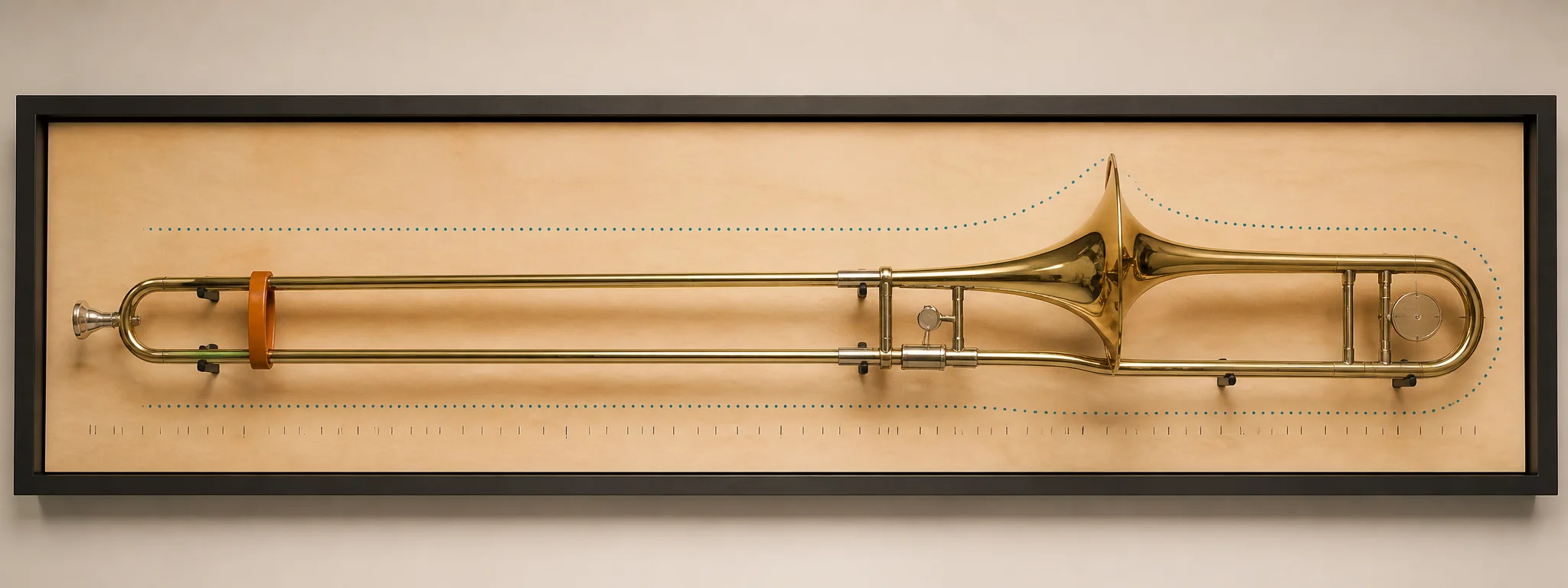
Physics and mechanics. How a lip buzz becomes a standing wave, and why the slide goes out to go lower.
Enter →
Move one mechanism. Watch tube length, pitch, hand distance and waveform change as a single physical system.
start here · the guided path
A step-by-step course that teaches one idea at a time on the horn and puts it straight under your hands. From your first buzz to clean, connected playing — no quizzes, progress saved.
▶ Jam: play along to a tune →∑ The science of the horn →♪ The listening room: why this instrument →⊙ The F attachment, measured →✎ Teach it in a maths or science class →
the reference library
Already playing? Jump straight to any topic. The guided path above weaves these together into a route; here they’re open sandboxes to explore and drill freely.
Physics and mechanics. How a lip buzz becomes a standing wave, and why the slide goes out to go lower.
Seven positions × the harmonic series — every note the horn can play, drawn as a grid you can fly through.
Bass clef from zero, sequenced by harmonic series rather than alphabet. The mic listens.
Any interval, up or down, from any note — and every connection from it: when the slide moves, when only the lips do.
Every key, ten scales, and the classic practice patterns — each drawn as a route along the slide, textbook or smart.
Arpeggios on a one-note-at-a-time instrument: any chord, every inversion, four shapes, and where each tone sits on the slide.
What the thumb trigger really does to the slide: every position measured in centimetres, side by side, and when to use it.
Play the real horn in front of a class while the screen measures it. Ready-made demonstrations for maths and science, ages 11–18.
the method library
Every module is woven with the foundational literature of the trombone — Arban, Rochut and Bordogni, Remington, Kopprasch, Schlossberg. The original notation, untouched. The animated grid and the listening ear, added.
the maths & physics of this instrument
Every other instrument in the band is built out of steps — 88 fixed keys, frets, valves that bolt on fixed lengths of pipe. The trombone has none of it: a tube that slides smoothly through every length in between, so it plays every pitch in between too. It is the one instrument in the room that is a continuous interval rather than a set of dots, and almost everything below follows from that single fact.
Inverse proportion · the reciprocal graph
On one lip setting, f × L = 319 Hz·m, so f = 319 ÷ L. First position holds 2.74 m and sounds 116.5 Hz; seventh holds 3.87 m and sounds 82.4 Hz. Change rung and you get a new constant, same curve.
You can slide along the graph with your arm, and hear the curve while you draw it.
open it →
Geometric sequences vs arithmetic ones
Each position drops one semitone, but the gaps grow 8.1 → 8.6 → 9.1 → 9.7 → 10.3 → 10.9 cm — every one is the last × 2^(1/12) = 1.0595.
Equal musical steps are equal multiplications, not equal distances — which is why seventh position is a stretch.
open it →
Coordinates · continuous versus whole-number axes
Any note = (slide position, harmonic partial). Across is continuous — position 3½ is a real place. Up is whole numbers only: there is no partial 3½.
One picture holding both kinds of number, on an instrument where you can play each axis separately.
open it →
Multiples · the harmonic series
Without moving the slide, the same tube sounds 58.3 × 1, 2, 3, 4 … Hz — the pedal note and its multiples. The everyday B♭ is rung 2; your lips choose the rung.
The multiples aren't drawn on a diagram — you select them with your face.
open it →